
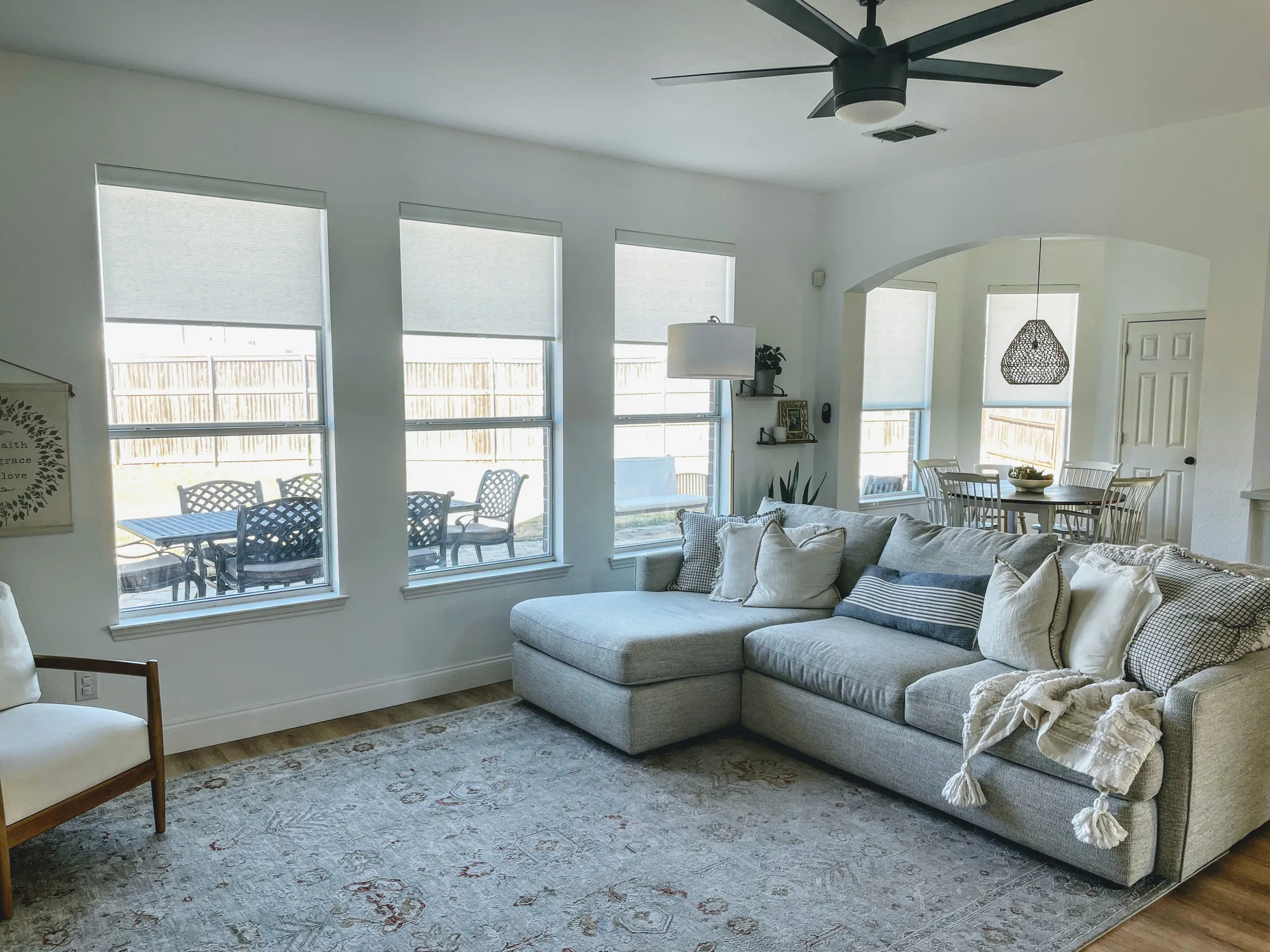
A media room has one job: make the screen the brightest thing in the room. Texas afternoon sun has other plans. Getting a media room dark at 4pm in July is a solvable problem, but it takes more than a shade labeled blackout.
Why blackout fabric alone is not enough
Blackout fabric stops light through the material, but light does not need the material: it slips around the edges of any inside-mounted shade. In a dark room those edge gaps read as glowing frames. The fix is fit and overlap, which is why media rooms reward professional measurement more than almost any other room.
The systems that get rooms dark
- Blackout cellular shades, whose side tracks close the edge gap that defeats most shades
- Outside-mounted blackout rollers sized past the trim, so the overlap swallows the halo
- Layered treatments: a blackout shade plus side-hemmed drapery kills the last leaks and improves the acoustics too
Motorize it and set a scene
A media room is where motorization stops being a gadget: one button drops every shade before the movie starts. Motorized blackout shades also pair with the lighting scene on smart systems, so movie mode means the room, not just the screen.
The free in-home consultation is where this gets easy: we measure the actual windows, look at where the light comes from, and quote the system that fits how dark you want the room to go.