Texas builders love wide glass, and eventually every wide-glass owner asks the same question: can one shade cover all of that? Sometimes. Width limits are physics, not policy, and knowing them early shapes the design.
Why width limits exist
A roller shade is fabric on a tube, and both have limits: past a certain span, tubes deflect in the middle and fabrics travel unevenly, telegraphing as a shade that walks sideways over months. Cellular and roman shades meet similar limits in their own mechanisms. Most product lines run out somewhere before twelve feet, narrower for heavier fabrics.
Coupled shades: one look, multiple mechanisms
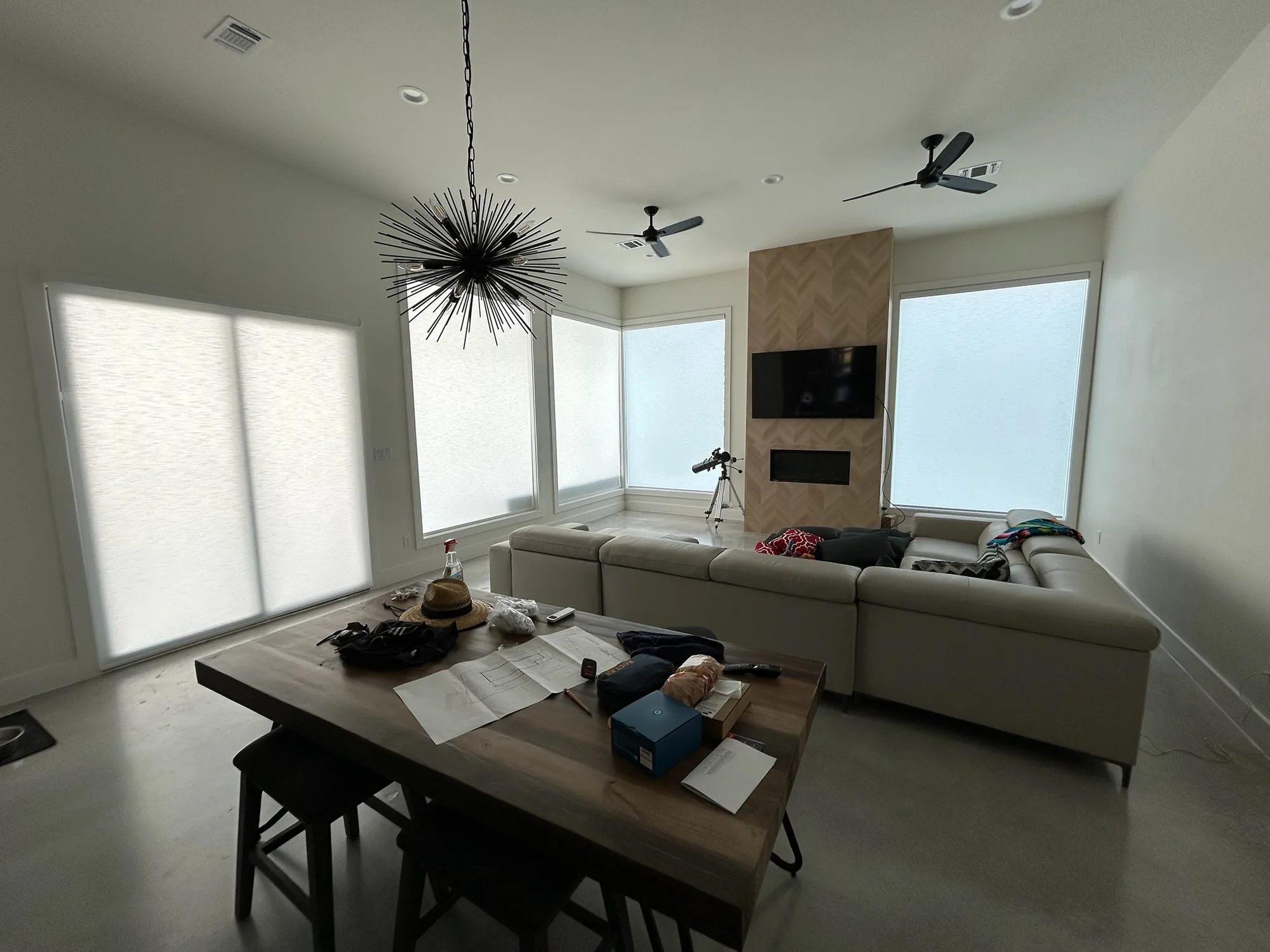
For wall-of-glass spans, coupled systems run two or three shades on aligned brackets, moving together under one control. The seams read as thin vertical lines that disappear into window mullions when the measuring is done thoughtfully, and motorized grouping makes the bank behave as a single gesture.
Design moves that flatter wide spans
- Align shade seams with the window's own mullions so the eye reads structure, not interruption
- Motorize the bank: synchronized travel is what sells the single-shade illusion
- On patio sliders, consider panel track shades, which were designed for exactly this geometry
Wide spans are measurement-critical: deflection, bracket placement and seam alignment all come from numbers taken at the wall. That is in-home consultation territory, and it is free.