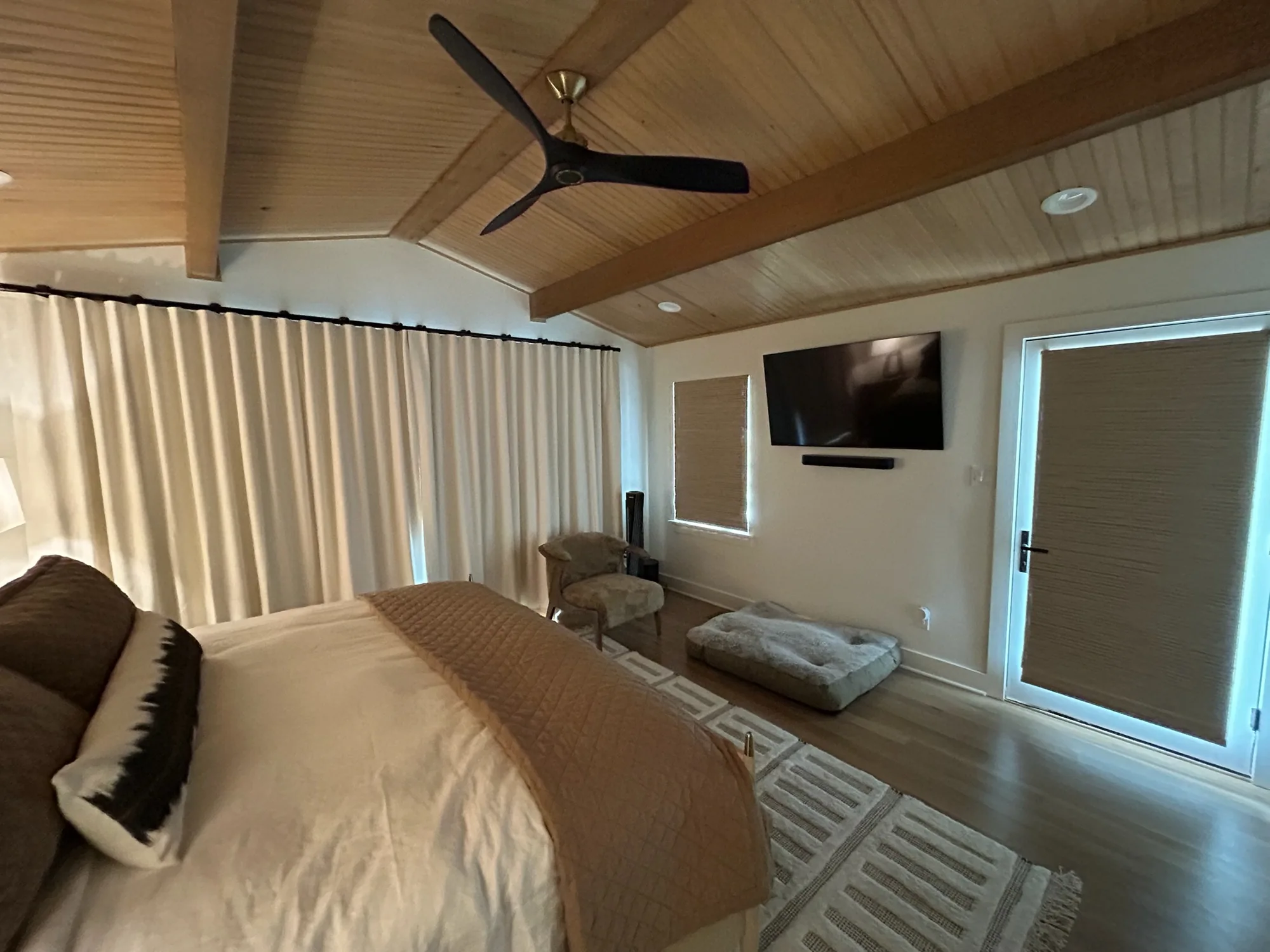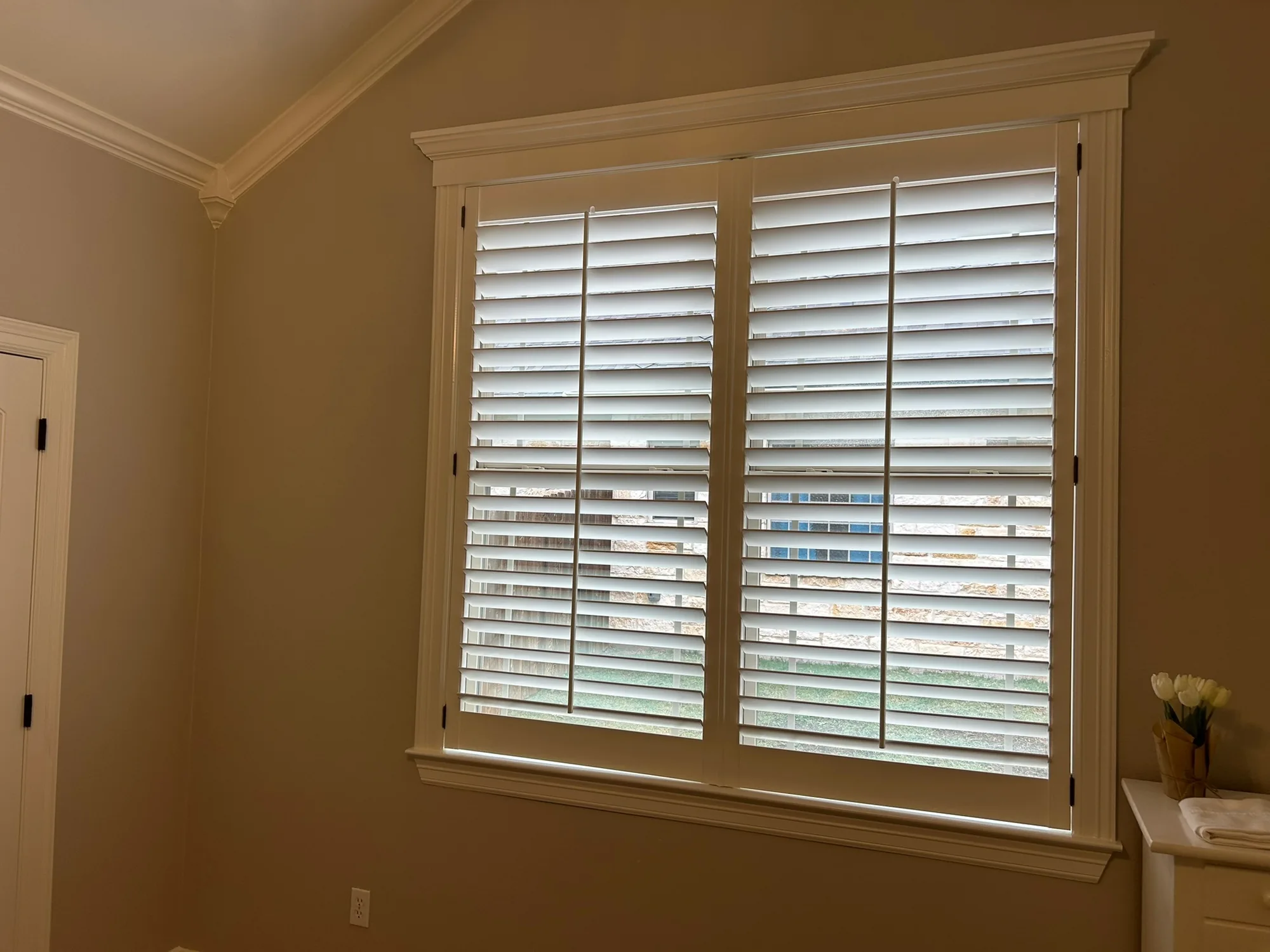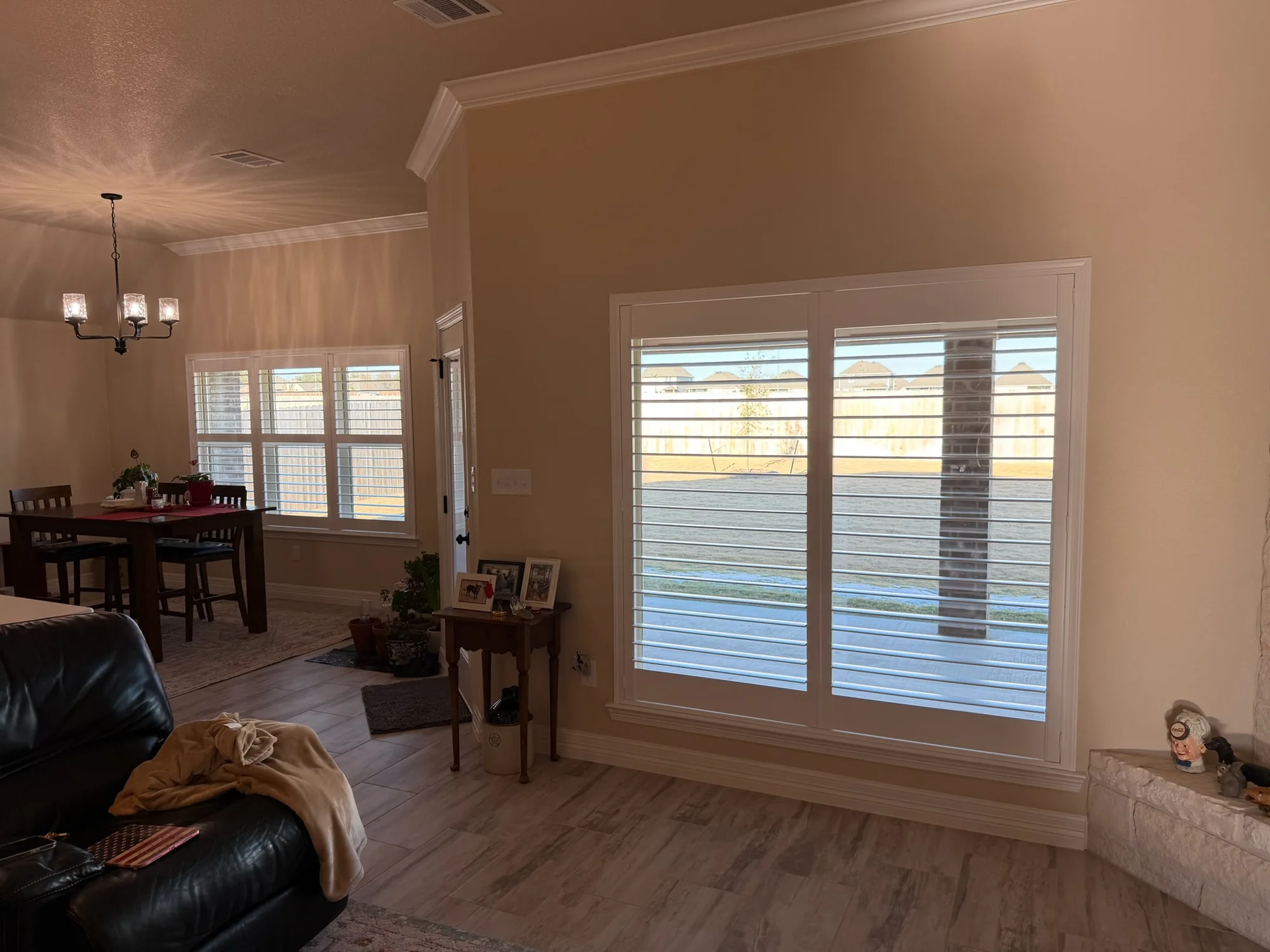
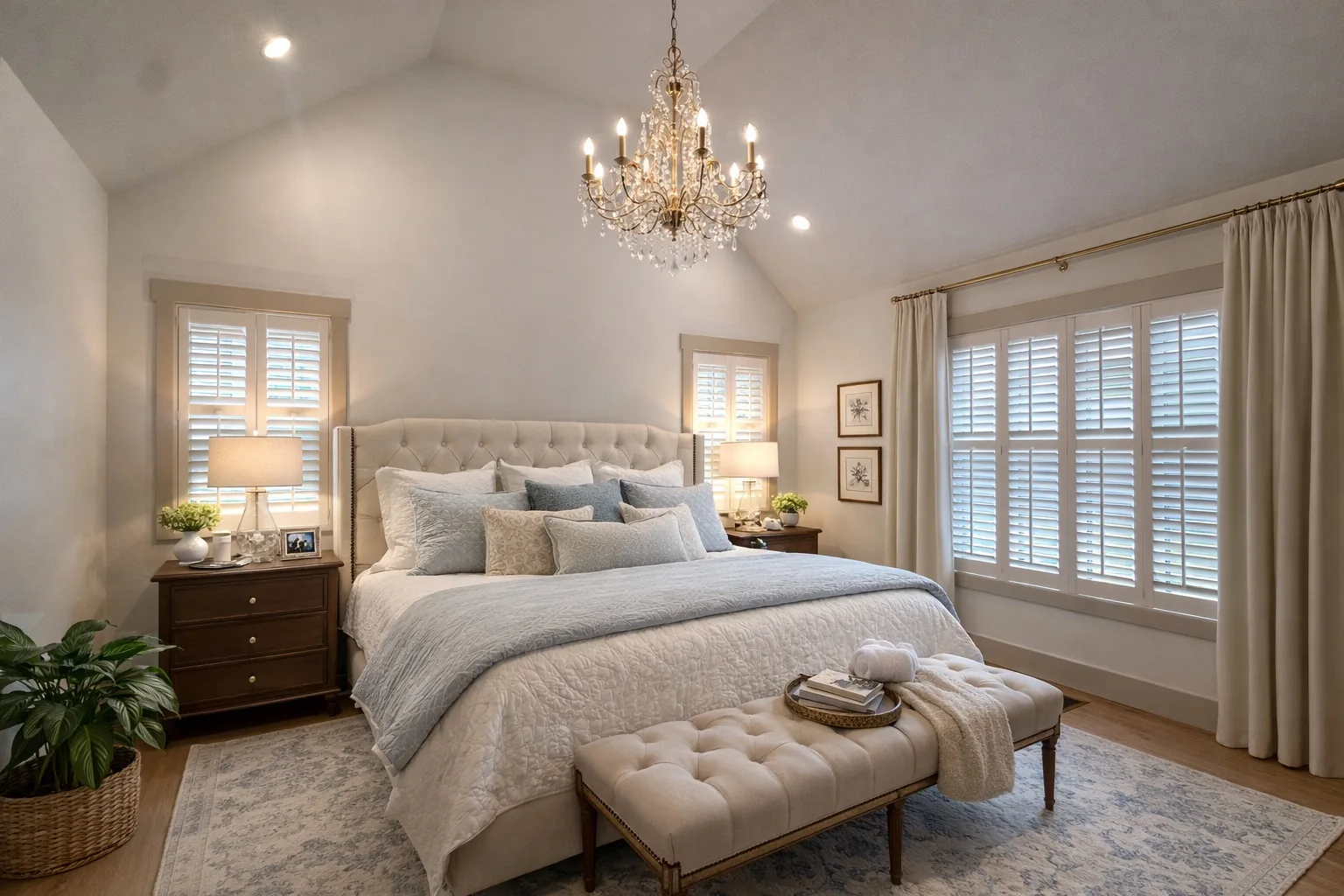
Short answer: yes, curtains over plantation shutters are one of the most common ways to finish a room. The one rule is mechanical: the drapery has to leave room for the shutter panels to swing open and the louvers to tilt. Hang the rod high and wide, and the curtains add softness, color and height that shutters alone do not.
Why pair them
Plantation shutters behave like architecture. They join the trim, give the window crisp horizontal lines, and handle light and privacy every day. In a living room that is often all a window needs. In a bedroom or a formal room, all those hard lines can feel cool, and drapery warms them up.
- Softness: fabric breaks up the lines of the louvers and the frame.
- Color and pattern: shutters are usually white or stained, so drapery is where the room's color comes in.
- Height: a rod mounted near the ceiling makes the window, and the room, look taller.
- Darkness: closed shutters still pass some light at the louver edges. Drapery drawn over them covers it, which helps in bedrooms.
- Heat: lined drapery drawn over shutters adds one more layer between a west-facing window and the room on summer afternoons.
- Sound: fabric softens echo in rooms with hard floors and high ceilings.
How to hang curtains with plantation shutters
Shutter panels are hinged and swing into the room. When they are open, they fold flat beside the window frame. Curtains hung tight to the frame land right where the panels need to go, so the shutters end up staying closed. Work through it in this order:
- Shutters first. Know where the panels swing and how wide they are when folded open before choosing the rod.
- Rod height. Mount the rod well above the window frame, often closer to the ceiling than to the top of the trim.
- Rod width. Extend the rod past the trim far enough that the stacked curtains rest on the wall beyond the opened shutter panels. A common rule of thumb is 8 to 12 inches past the trim on each side, more where the shutter panels are wide.
- Bracket projection. Choose brackets that hold the rod far enough off the wall for the fabric to hang in front of the shutter frame and any tilt rod.
- Length. Decide how the curtains meet the floor (below).
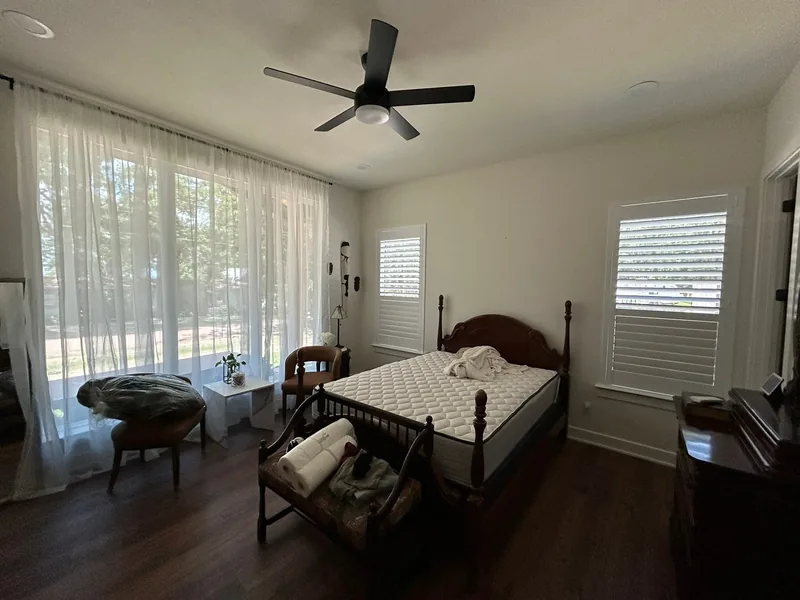
Curtain length
- Skimming the floor: the cleanest look and the easiest to live with. A good default for Texas homes with tile, wood or concrete floors.
- A slight break: an inch or so of fabric resting on the floor. Softer, and forgiving if the floor is not perfectly level.
- Puddled: several inches pooled on the floor. Formal and dramatic, best in rooms with little foot traffic and no pets.
Stationary panels or working drapery
Stationary side panels frame the window and never close. They are the simplest pairing, since the shutters handle light and privacy and the panels only need to look good. They also take less fabric. If a panel crowds the shutter hinge, a tieback or a holdback mounted on the wall pulls it clear.
Working drapery draws across the whole window, over the closed shutters. It suits bedrooms that need more darkness and rooms where you want a softer look at night. It needs a full-width rod and enough stacking room on each side to clear the shutter panels. On wide windows, drapery can also be motorized on a track and drawn by remote or schedule. More in what custom drapery is.
Valances and cornices over plantation shutters
A valance is a short fabric treatment across the top of the window; a cornice is a firmer, box-like version, usually upholstered. Either can finish the top of a shuttered window and hide the rod.
Mount it high enough that it clears the top of the shutter panels and the louvers can tilt fully open without hitting it. Coordinate the valance with the drapery, if there is any, rather than the shutters. Keep it simple: a tailored valance or a clean cornice looks current, while heavy swags and stacked layers are what date a shuttered room.
Choosing curtain colors for your shutters
- White shutters: ivory, linen and soft neutrals look calm. Match the white family: warm white shutters sit best with warm, creamy fabrics, and bright cool white with crisper ones.
- Stained shutters: warm colors and richer textures echo the wood. Deep greens, rust and camel all work against a mid-tone stain.
- Patterns: shutters are a quiet backdrop, so a patterned fabric can be the feature without the window looking busy.
- Sheers: keep the daylight and add movement. A good fit for living rooms where the shutters already handle privacy.
Strong Texas afternoon light pushes colors warm, so judge fabric next to the shutters at the time of day the room gets used. Our guide to white or stained shutter finishes covers the shutter side of the pairing, and real wood vs faux wood shutters covers which materials take stain.
When curtains are optional
- Kitchens and full bathrooms, where moisture and cooking are hard on fabric and faux wood shutters do the job alone. See shutters for bathrooms.
- Windows beside a door or a tall piece of furniture, where the drapery has nowhere to stack
- Cafe shutters, which usually look best with a simple valance or side panels and nothing over the open top
- Shutters on French doors or sliding doors: possible, but only with a rod wide enough that the drapery stacks clear of the doors
- Rooms where the trim and the view are the feature
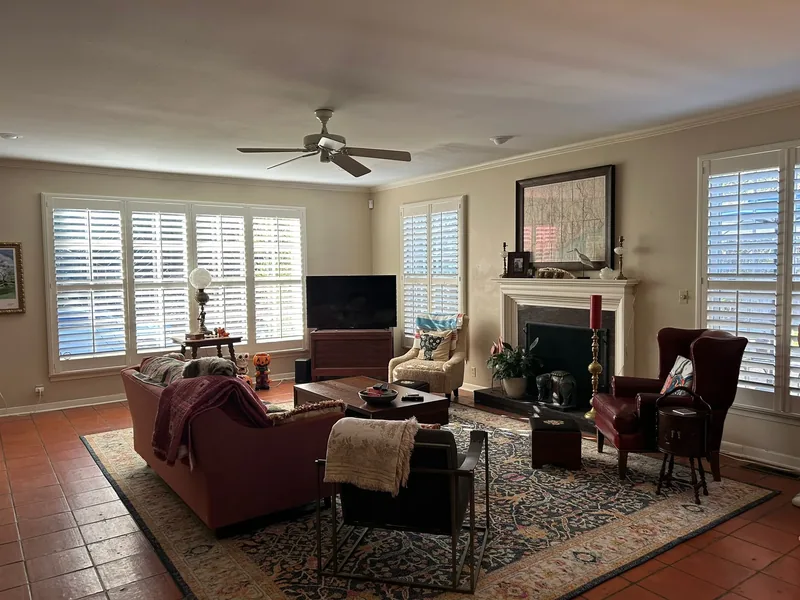
Planning both together
We install plantation shutters and custom drapery, so the rod position can be planned around the shutter swing from the start instead of discovered after. The in-home consultation is free, we bring samples to your home, and the quote is written with installation included. See what happens at a consultation.